Do Citizens of the U.s. Have the Right to Read Gov't Bills Before They Are Passed
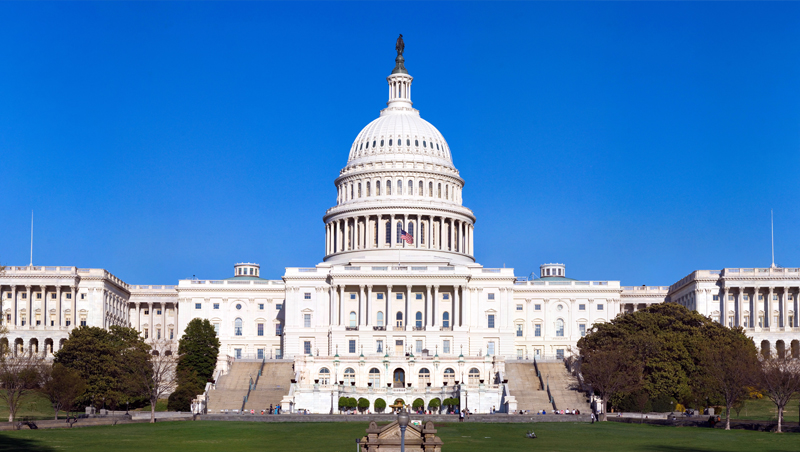
The Usa Congress is made upward of the House of Representatives and the Senate. Acquire more about the powers of the Legislative Branch of the federal regime of the United States.
Established by Article I of the Constitution, the Legislative Branch consists of the House of Representatives and the Senate, which together form the United states of america Congress. The Constitution grants Congress the sole authority to enact legislation and declare war, the right to ostend or pass up many Presidential appointments, and substantial investigative powers.
The Business firm of Representatives is made upwardly of 435 elected members, divided among the 50 states in proportion to their total population. In addition, at that place are 6 non-voting members, representing the District of Columbia, the Commonwealth of Puerto Rico, and 4 other territories of the United States. The presiding officeholder of the chamber is the Speaker of the House, elected by the Representatives. He or she is tertiary in the line of succession to the Presidency.
Members of the House are elected every two years and must exist 25 years of age, a U.S. citizen for at least seven years, and a resident of the state (but non necessarily the district) they represent.
The House has several powers assigned exclusively to it, including the power to initiate acquirement bills, impeach federal officials, and elect the President in the instance of an electoral higher necktie.
The Senate is composed of 100 Senators, 2 for each country. Until the ratification of the 17th Subpoena in 1913, Senators were chosen by state legislatures, not past popular vote. Since then, they take been elected to six-year terms by the people of each state. Senator's terms are staggered then that about 1-third of the Senate is up for reelection every ii years. Senators must be 30 years of age, U.S. citizens for at least nine years, and residents of the country they represent.
The Vice President of the United States serves as President of the Senate and may cast the decisive vote in the event of a necktie in the Senate.
The Senate has the sole power to confirm those of the President'south appointments that require consent, and to ratify treaties. There are, however, ii exceptions to this dominion: the Business firm must also approve appointments to the Vice Presidency and any treaty that involves foreign merchandise. The Senate besides tries impeachment cases for federal officials referred to information technology past the Firm.
In guild to pass legislation and transport information technology to the President for his signature, both the House and the Senate must laissez passer the same bill past majority vote. If the President vetoes a bill, they may override his veto by passing the bill again in each sleeping room with at least two-thirds of each body voting in favor.
The Legislative Process | Powers of Congress | Government Oversight
The Legislative Procedure
The first step in the legislative process is the introduction of a bill to Congress. Anyone tin write information technology, merely only members of Congress tin innovate legislation. Some important bills are traditionally introduced at the request of the President, such every bit the annual federal budget. During the legislative process, however, the initial bill can undergo desperate changes.
Afterwards being introduced, a bill is referred to the advisable commission for review. There are 17 Senate committees, with 70 subcommittees, and 23 House committees, with 104 subcommittees. The committees are not set in stone, merely change in number and form with each new Congress as required for the efficient consideration of legislation. Each committee oversees a specific policy area, and the subcommittees have on more than specialized policy areas. For instance, the Business firm Committee on Ways and Means includes subcommittees on Social Security and Trade.
A bill is first considered in a subcommittee, where it may be accepted, amended, or rejected entirely. If the members of the subcommittee agree to move a bill forward, it is reported to the full commission, where the procedure is repeated again. Throughout this stage of the process, the committees and subcommittees phone call hearings to investigate the merits and flaws of the neb. They invite experts, advocates, and opponents to appear before the committee and provide testimony, and tin compel people to appear using subpoena power if necessary.
If the full committee votes to approve the bill, it is reported to the flooring of the House or Senate, and the majority party leadership decides when to place the bill on the calendar for consideration. If a beak is particularly pressing, it may be considered right away. Others may look for months or never exist scheduled at all.
When the bill comes upwardly for consideration, the House has a very structured debate process. Each member who wishes to speak simply has a few minutes, and the number and kind of amendments are usually limited. In the Senate, debate on nigh bills is unlimited — Senators may speak to issues other than the beak under consideration during their speeches, and any subpoena can be introduced. Senators can apply this to filibuster bills under consideration, a procedure by which a Senator delays a vote on a nib — and by extension its passage — by refusing to stand down. A supermajority of lx Senators can interruption a filibuster by invoking cloture, or the cession of argue on the bill, and forcing a vote. Once debate is over, the votes of a simple majority passes the bill.
A bill must laissez passer both houses of Congress before it goes to the President for consideration. Though the Constitution requires that the ii bills accept the verbal same wording, this rarely happens in practise. To bring the bills into alignment, a Conference Commission is convened, consisting of members from both chambers. The members of the committee produce a briefing written report, intended as the final version of the bill. Each chamber so votes over again to approve the conference study. Depending on where the bill originated, the final text is then enrolled by either the Clerk of the House or the Secretary of the Senate, and presented to the Speaker of the House and the President of the Senate for their signatures. The pecker is and then sent to the President.
When receiving a bill from Congress, the President has several options. If the President agrees substantially with the pecker, he or she may sign it into police force, and the bill is then printed in the Statutes at Large. If the President believes the police force to be bad policy, he may veto it and send it back to Congress. Congress may override the veto with a two-thirds vote of each chamber, at which indicate the bill becomes law and is printed.
In that location are 2 other options that the President may exercise. If Congress is in session and the President takes no activity within 10 days, the bill becomes law. If Congress adjourns before 10 days are up and the President takes no action, and so the bill dies and Congress may not vote to override. This is called a pocket veto, and if Congress however wants to pass the legislation, they must begin the entire process anew.
Powers of Congress
Congress, equally i of the three coequal branches of government, is ascribed pregnant powers by the Constitution. All legislative ability in the government is vested in Congress, significant that it is the only part of the regime that can make new laws or change existing laws. Executive Branch agencies issue regulations with the total force of law, but these are only nether the authority of laws enacted past Congress. The President may veto bills Congress passes, but Congress may also override a veto by a two-thirds vote in both the Senate and the House of Representatives.
Commodity I of the Constitution enumerates the powers of Congress and the specific areas in which information technology may legislate. Congress is also empowered to enact laws deemed "necessary and proper" for the execution of the powers given to whatsoever part of the authorities under the Constitution.
Office of Congress's exercise of legislative authorization is the institution of an annual budget for the regime. To this terminate, Congress levies taxes and tariffs to provide funding for essential government services. If enough money cannot be raised to fund the government, then Congress may also qualify borrowing to brand up the difference. Congress can also mandate spending on specific items: legislatively directed spending, commonly known as "earmarks," specifies funds for a particular project, rather than for a government agency.
Both chambers of Congress accept extensive investigative powers, and may hogtie the production of evidence or testimony toward whatever end they deem necessary. Members of Congress spend much of their fourth dimension belongings hearings and investigations in committee. Refusal to cooperate with a Congressional subpoena can event in charges of contempt of Congress, which could result in a prison house term.
The Senate maintains several powers to itself: It ratifies treaties past a two-thirds supermajority vote and confirms the appointments of the President by a majority vote. The consent of the House of Representatives is also necessary for the ratification of merchandise agreements and the confirmation of the Vice President.
Congress also holds the sole ability to declare war.
Government Oversight
Oversight of the executive branch is an important Congressional check on the President's power and a balance against his discretion in implementing laws and making regulations.
A major mode that Congress conducts oversight is through hearings. The Firm Committee on Oversight and Government Reform and the Senate Committee on Homeland Security and Government Diplomacy are both devoted to overseeing and reforming government operations, and each committee conducts oversight in its policy surface area.
Congress also maintains an investigative organization, the Government Accountability Office (GAO). Founded in 1921 equally the General Accounting Role, its original mission was to inspect the budgets and financial statements sent to Congress by the Secretary of the Treasury and the Director of the Role of Management and Budget. Today, the GAO audits and generates reports on every attribute of the government, ensuring that taxpayer dollars are spent with the effectiveness and efficiency that the American people deserve.
The executive branch also polices itself: Lx-four Inspectors Full general, each responsible for a unlike agency, regularly audit and report on the agencies to which they are attached.
Source: https://obamawhitehouse.archives.gov/1600/legislative-branch

Post a Comment for "Do Citizens of the U.s. Have the Right to Read Gov't Bills Before They Are Passed"