What Did the Supreme Court Say as to Why Bible Reading in School Was Dangerous Dangerous
Review
When the Court Took on Prayer and the Bible in Public Schools
By | June 25, 2012 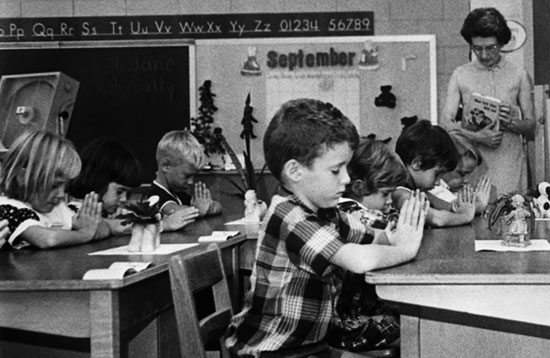
(Bettmann/Corbis / AP Images)
The Bible, the School, and the Constitution: The Clash That Shaped Mod Church-State Doctrine
By Steven K. Greenish
Oxford University Press, 2012
Today marks the fiftythursday ceremony of a court instance that changed the way Americans retrieve near organized religion in public schools. On June 25, 1962, the United States Supreme Court decided in Engel v. Vitale that a prayer canonical by the New York Lath of Regents for use in schools violated the First Amendment by constituting an establishment of religion. The post-obit year, in Abington Schoolhouse District five. Schempp, the Court disallowed Bible readings in public schools for similar reasons. These two landmark Supreme Court decisions centered on the place of religion in public education, and especially the place of Protestantism, which had long been accepted as the given American organized religion tradition. Both decisions ultimately inverse the face of American civil society, and in plow, helped usher in the last half-century of the civilisation wars.
The reaction to the cases was firsthand and intense, sensationalized past the media as kick God out of the public school. Among America's Christian leaders, nevertheless, the response was surprisingly mixed. Some conservatives like Baton Graham and Cardinal Francis Spellman, along with the more than liberal Episcopal Bishop James A. Pike, decried the decisions. Others, including the National Association of Evangelicals, applauded the Court for appropriately separating the state from the affairs of the church. Christianity Today, the flagship evangelical mag, supported the prayer decision considering the editors thought it was essentially a pro forma do that had become secularized.
Despite the shock (either of anger or appreciation) that many American religious leaders expressed over the Supreme Court's deportment, these rulings did not come out of nowhere. What was not every bit well known at the time, and still is not widely recognized, is that the Engel and Abington decisions arrived on a trajectory from judicial contests and public discussions that had occurred nigh 100 years before. In his latest volume, The Bible, the Schoolhouse, and the Constitution, law professor and constitutional historian Steven 1000. Green meticulously details this history, illustrating how the foundations for the Courtroom decisions in the second one-half of the twentieth century were established during the second one-half of the nineteenth century. Green carefully elucidates how "[t]he debate over the Schoolhouse Question was the closest that Americans take ever come to having a national chat about the meaning of the religion clauses of the Constitution."
Greenish's work brings to heed some other of import book on this menses, Philip Hamburger'south Separation of Church and State. Light-green acknowledges Hamburger's book every bit "comprehensive and influential," only calls information technology "thematically flawed." And in this criticism, the arguments of Green and Hamburger are gear up into precipitous relief. Hamburger argues that current church and state doctrine does not go along from the Starting time Amendment. Rather, this doctrine evolved principally out of virulent nineteenth century anti-Catholicism. While Light-green acknowledges that anti-Catholicism played an of import role, he suggests that Hamburger's emphasis on anti-Catholic sentiment for church-state law is overdrawn. Green argues for more nuanced, though peradventure more mundane, sources of contention: the evolving shape of nonsectarian education and, inextricably related to this, the shifting positions on public funding for parochial schools.
Green anchors his narrative in histories of the so-called Cincinnati "Bible Wars" of 1869-73, and the resulting court case, Minor v. Lath of Pedagogy. In the mid-nineteenth century, Cincinnati was an economic hub of the upper Mississippi River valley, drawing immigrants to its flourishing commercial environment. It was a religiously and ethnically diverse urban center, comprised of Irish Catholics, German Lutherans, and Freethinkers, as well as big Jewish congregations whose rabbis were national Jewish leaders. A system of Catholic schools had existed since the 1840s, but with an influx of Cosmic immigrants, by 1869 these schools' enrollment ballooned to perhaps as high as fifteen,000, rivaling the enrollment of Cincinnati'south pubic schools, which served some 19,000 students. The school lath put forth resolutions to merge the systems. Under the agreement, religion would not be taught in the schools during the calendar week, but Catholics could use the buildings on the weekends for religious instruction. Catholic leaders proposed a complementary program, stipulating that in that location would exist no Bible reading in the schools during the week since it was the Protestant Bible (i.e the King James version) from which readings were drawn. Though the board passed the resolution in 1867, a lawsuit rapidly followed, petitioning the courtroom to reinstate Bible reading. The result was the landmark 1870 case Pocket-sized v. Board of Education, in which the Ohio Supreme Courtroom upheld the school board'southward resolution to remove Bible readings from the school twenty-four hour period.
In response to these "Bible Wars," politicians called for amendments to the U.South. Constitution. Some proposed rewriting the Preamble to the Constitution to recognize the sovereignty of God in the formation and law of the U.s.. Others wanted a new amendment explicitly guaranteeing religious freedom.
Neither of these proposed amendments got very far. Somewhat more than successful was the subsequent Blaine Amendment. James A. Blaine, a Republican congressman with presidential aspirations, took note of the national receptivity to a convention spoken communication President Ulysses S. Grant gave in 1875 in Des Moines. Grant called for the establishment of free, nonsectarian schools, which left religious instruction to the family and church. Blaine proposed a constitutional amendment to that effect:
No state shall make any constabulary respecting an establishment of faith, or prohibiting the free exercise thereof; and no coin raised by revenue enhancement in any State, for the support of the public schools or derived from whatsoever public fund, shall e'er exist under the control of any religious sect, nor shall any coin and then raised e'er exist divided between religious sects or denominations.
Serious debate took place over this and alternative language, debates that, in the congressional record, accept up some 23 pages. Though the Blaine Amendment failed (falling 4 votes short in the Senate), the debate surrounding it engaged the nation on the intersections of church, state, and educational activity in an unprecedented mode. In the wake of the Blaine contend, 21 states passed legislation that forbade direct governmental assist to religiously affiliated schools. But Green notes that before Blaine, 17 states had already adult such legislation. Consequently, Dark-green'south principal argument runs counter to that of Philip Hamburger, that the no-funding trend had a history that preceded the heightened anti-Cosmic sentiment.
In these debates from the latter one-half of the nineteenth century, Light-green sees foreshadowing for our ain time. He writes that "the School Question served as a proxy for how the nation addresses a host of other challenges—immigration, religious pluralism, labor and competition—then the debate and accompanying rhetoric played on a host of hopes, fears, and prejudices."
Attempts to reintroduce Bible reading into the schools continued, and into the twentieth century, Bible reading was still allowed in many of the nation'southward public schools. Even so it had go so nonsectarian, or at to the lowest degree considered equally such, that by the mid-twentieth century, many courts ruled that such practices were actually devoid of religious purpose. Some schools introduced curriculum that taught the Bible as literature (a movement that is again gaining some traction today). Only this new manner of approaching Christianity's most fundamental text, which some took as an attempt to secularize the Bible, strongly suggests that this particular civilisation state of war drew to a close. Religious exercises in public schools were no longer authorized by law in many states, finer ending, to utilize Green's dramatic phrasing, the "Republic of the Bible."
Light-green argues that the nineteenth-century transformation from nonsectarian to secular education, along with the institutionalization of the educational innovations of Horace Mann and John Dewey, led to a legal disestablishment of religion in public schools. It was a cumulative process of reconciling "the evolving goals for public schooling with a growing religious pluralism and emergent ramble principles," ane that was brought to a constitutional climax with the Engel and Schemmp decisions in the 1960s. And this is mayhap the greatest contribution of Green's new book: while many Americans believed in 1962—and continue to believe today—that the crisis over the proper relationship between religion and public instruction arose full diddled in the chambers of the Supreme Courtroom, in fact these changes were a century in the making.
Today, America faces 2 competing, only not necessarily incompatible, realities. Start, Americans speak in the secular terms philosopher Charles Taylor lays out in A Secular Age. Such secularism is neither the subtraction of religion from the public square, nor the refuse of personal religious belief and practice, assumed to be a result of modernity.Rather, it is, as Taylor puts it, "a motility from a gild where belief in God is unchallenged and indeed, unproblematic, to i in which it is understood to exist 1 option amid others, and oftentimes non the easiest to embrace." Second, many scholars of religion believe that, exterior of India, the U.Due south. is the most religiously various land in the world. What role should "secularized" public schools play in educating their students near the very "religious" (and religiously diverse) nation of which they are citizens?
In Does God Make a Departure: Taking Religion Seriously in Our Schools and Universities, Warren Nord argues that we must brainwash more broadly about faith in ways that engender connection and understanding to enable civil discourse, discourse that involves our about deeply held beliefs. At that place are signs that the pendulum may be beginning to swing back to a position like that advocated by Nord: where instruction virtually religion may be more widely accepted in our universities and our public schools. Information technology is at one time encouraging and disheartening to annotation that some of the same forces at work 150 years ago, and so ably traced by Professor Greenish, are with us still. Only as he reminds usa, incremental progress characterized the process then. And then it must exist now.
Michael D. Waggoner is the editor of the journal, Organized religion & Teaching. He teaches at the University of Northern Iowa Academy.
Source: https://religionandpolitics.org/2012/06/25/when-the-court-took-on-prayer-the-bible-and-public-schools/

Post a Comment for "What Did the Supreme Court Say as to Why Bible Reading in School Was Dangerous Dangerous"